I finally freed myself from draining relationships and decided to aim for a way of working that's my own. But I never imagined that getting remote work off the ground — in an environment with few time constraints and zero pressure or coercion from anyone else — would come with so many enemies and obstacles!
Today, of all the enemies I've faced over these past six months, I've analyzed my countermeasures for two of them thoroughly — "heat" and "drowsiness" — and thought hard about what actually works for me.
📋 What you'll find in this article
Why menopausal hot flashes, facial sweating, and dizziness clash so badly with remote work
Of all the common heat countermeasures, only the ones that actually helped me
The 3 cooling items I genuinely rely on (cool ring, ice pack, handheld fan)
My personal conclusion on my most troublesome enemy: drowsiness
A "things you can do in 5 or 30 minutes" list that beats drowsiness and gets chores done
Enemy #1: Heat — a midsummer baby who can't stand summer
First, about the heat.
Every single day, the TV is full of alarming news: "Record-high temperatures!" "The thermometer can't even measure it!" "○○ people rushed to hospital for heatstroke!" We're seeing temperatures across the country at body-temperature levels — even beyond the temperature of a fever — where old-fashioned tricks like sprinkling water on the ground are utterly useless. Days when a screen door and a fan are enough to stay comfortable have become truly rare.
Some people say they'd take heat over cold any day, but even though I was born in midsummer, I've hated summer for as long as I can remember. I recently found an old diary of mine, and it seems I'd been suffering from hot flashes and dizziness since my thirties.
My face sweats terribly, and even when it isn't that hot, humidity makes me overheat and grow lightheaded, and my head goes foggy. Once that happens, my brain simply won't work. For a remote worker, that's a matter of life and death.
When I looked it up online, there were all sorts of heat countermeasures. Here they are.
🌡️ Heat countermeasures (the commonly cited ones)
Managing room temperature with air conditioning and fans
Using blackout/heat-blocking curtains and bamboo blinds (sudare)
Frequent hydration and salt intake
Cooling towels and cooling goods (contact-cooling fabrics, etc.)
Shifting outings to the cooler morning and evening hours
Looking through them all, they were things I already do as a matter of course. In our home, the air conditioner stays on all day at 28°C, alongside a fan. Bamboo blinds hang outside the windows year-round. On strong-sun days, I air the house out first thing in the morning, then close the storm shutters.
I get plenty of salt from food, and hydration matters for preventing blood sugar spikes too, so I've long had that covered. As for clothing, tight things have always made me feel unwell, so I regulate with a sleeveless dress plus a cardigan. The last two (baths and outing times) don't really solve my particular problem.
The only genuinely new thing I could do to solve my problem was making use of cooling goods. I used to work at a 100-yen shop, which carried cooling towels and the like, so I tried all sorts. But cooling towels, handy and effective as they are, need frequent re-wetting, and worn around the neck they dampen my clothes — a little uncomfortable.
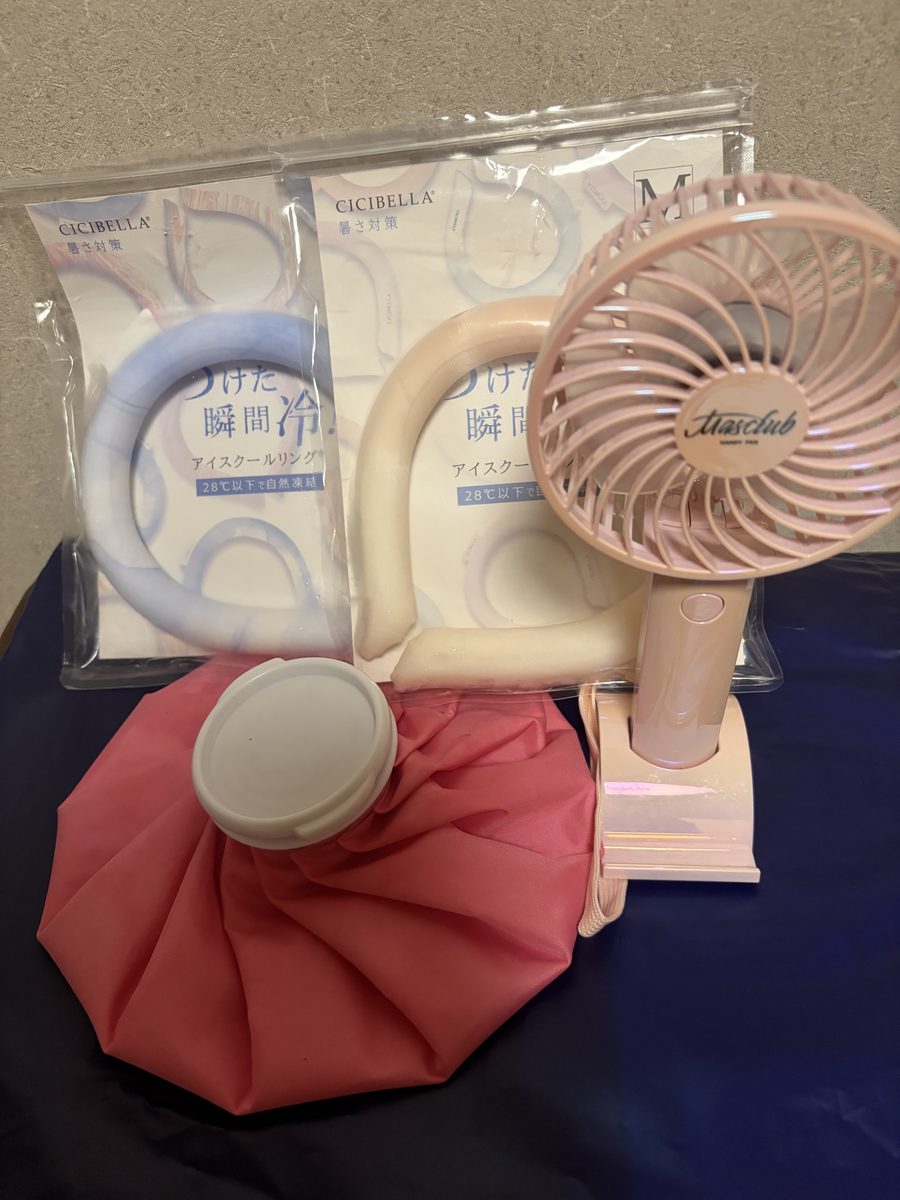
So the three things I actually rely on are these.
🍎 Shiny Apple's 3 favorite cooling goods
Rechargeable handheld fan — a big fan aimed straight at me chills my whole body, so I use a small type to cool just my face.
Cool ring — I have two, so I keep them in the freezer and alternate.
Ice pack (hyōnō) — when I get sleepy or my face flushes, I rest it on my head or cool my hands, neck, and face. Use it too much and I run out of ice for drinks, so when I go shopping and buy frozen food, I reuse the ice they pack it with by popping it straight into the ice pack (ha!).
The three items I actually rely on: cool rings (CICIBELLA, two colors), an ice pack, and a rechargeable handheld fan with a stand — all in pink, which lifts my mood 🍎
① Rechargeable handheld fan
The fan is rechargeable, so it's useless once the battery dies — which is why I'm planning to buy a second one soon. A model with a cooling plate you can press to your face and neck sounds lovely. Results may vary by product, but the one I use has three adjustable speeds and plenty of power, so I'm happy with it. I chose one that comes with a stand so it can stand on its own.
② Cool ring
The cool ring's drawback is that it loses its chill quickly, but since they're affordable, having several on hand and swapping them out keeps the coolness going constantly — very handy. With luck you can find them at a 100-yen shop, but they're cheap online too, and I find them useful even for cooking over an open flame in the kitchen.
③ Ice pack (hyōnō)
An ice pack does mean keeping ice made up in advance, and it's an old-fashioned tool, but it's the real MVP of my anti-drowsiness and anti-heat lineup. There are stainless-bottle types now, but since I also rest it on my head while I work, I use the traditional soft type.
⚠️ If the heat makes you feel "off," don't push through
Dizziness, lightheadedness, nausea, headache, a body temperature that won't come down, sweating that suddenly stops — these can be signs of heatstroke. Rest in a cool place right away and take water and salt. If it doesn't improve, or your mind feels hazy, see a doctor without hesitation (and don't hesitate to call emergency services). Because remote work means long stretches alone, it's important not to tough it out thinking "I'm still fine."
Enemy #2: Drowsiness — my most troublesome opponent
Now, the common methods for my most troublesome enemy, drowsiness, are as follows.
😴 Drowsiness countermeasures (the commonly cited ones)
Caffeine (coffee, tea)
Short naps (about 15–20 minutes)
Light exercise or stretching
Airing out the room
Washing or cooling your face and neck with cold water
Chewing gum
Getting sunlight or moving to a bright spot
Let me go through them one by one. First, caffeine — I think there's a problem here. A healthy adult's daily caffeine guideline is often cited as around 400 mg (roughly 3–4 cups of coffee), but combined with your constitution, condition, and other sources (tea, energy drinks, chocolate), individual variation is huge.
Too much caffeine can also cause insomnia, poorer sleep quality, palpitations, a raised heart rate, higher blood pressure, digestive strain, dehydration, and headaches, and it can affect you mentally too — more anxiety and irritability, plus a strong dependency risk. So it has its limits.
A short nap is an easy option for a remote worker, I thought. Even so, with no sense of pressure I'd probably oversleep, so I want to keep it as my last resort.
Light exercise or stretching is another well-known method. I'm bad at exercise, but I stretch often. Still, it often isn't enough to blow the drowsiness away, so I figured it doesn't necessarily have to be exercise. As I learned when researching drowsiness from blood sugar spikes for another article, exercise becomes a hurdle for people who dislike it — so when sleepiness hits, I stop working and instead do a household task I need to do anyway. Two birds with one stone.
Airing the room and getting sunlight are easy to do at once, but on their own they feel too weak to shake my fierce drowsiness.
And chewing gum. I'd love to, honestly, but my dental fillings often come loose, so I can't (cue the tears). For those who can, chewing gum while walking is said to activate the brain, so it seems like a good method.
In conclusion, my anti-drowsiness plan comes down to these two things.
🍎 My anti-drowsiness conclusion
Cool my head, face, hands, and neck with the ice pack, and wash my face.
Stand up and move my body.
Number 2 also works against my third enemy, "not enough time," so it's a two-birds method. To that end, I've decided to make a habit of routinely listing "things I can do in 5 minutes" and "things I can do in 30 minutes." Here are some I came up with.
⏱️ Things you can do in 5 minutes (examples)
Scrub the sink
Scrub the stovetop
Tidy the inside of my bag
Tidy my wallet
Organize just one drawer
Wipe the table thoroughly / tidy part of the food stock or cupboard
Vacuum for just 5 minutes
Mop for just 5 minutes (wipe with a disposable cloth)
Sing one favorite song
Find one unneeded item and throw it out
Boldly set a timer and sleep for just 5 minutes
⏱️ Things you can do in 30 minutes (examples)
Stretch / move along with a YouTube video
Take a walk
A quick bathroom clean
Fold and put away the laundry
Vacuum until the battery dies
Tidy and clean the fridge
Place the co-op grocery order
Check stock of daily goods and food
Iron
Prep for dinner
Boldly set a timer and sleep for just 30 minutes
I plan to dial the amount of movement up or down according to how sleepy I am. If there's something decided to do the moment I stand up, the hurdle is lower — and I get the bonus of clearing "things that have to be done" while shaking off the drowsiness.
And when I've tried all of the above and nothing works, I've decided to just rest as much as I want. Sleep as much as I want.
I also feel I need to work on improving my nighttime sleep quality. I keep looking at my phone right up until bed, but I sense that's something I should rein in. When my body is tired, I even thought maybe thinking hard about things I want to try someday — researching them, or bouncing ideas off an AI — might wake me up, so I'll give that a try.
Drowsiness is a truly troublesome problem for me. I'll keep researching better countermeasures. If you know a good method, please do tell me!
If you have a favorite heat or drowsiness trick of your own, I'd love to hear it — feel free to reach out from the contact page 🍎
👉 The "third enemy" waiting for me after this was the "not enough time" problem. The sequel — where I dig deep into why time-management techniques never stuck for me — is here.
* This article is based on my own research and personal experience. If you have worrying physical symptoms, or symptoms that persist, or any concerns, please consult a medical professional.
![[商品価格に関しましては、リンクが作成された時点と現時点で情報が変更されている場合がございます。]](https://hbb.afl.rakuten.co.jp/hgb/562d45fc.b6162a1f.562d45fd.eaca422c/?me_id=1279405&item_id=15578517&pc=https%3A%2F%2Fimage.rakuten.co.jp%2Fstylife%2Fcabinet%2Fitem%2F256%2Frm4256-02_2.jpg%3F_ex%3D240x240&s=240x240&t=picttext "[商品価格に関しましては、リンクが作成された時点と現時点で情報が変更されている場合がございます。]")

![[商品価格に関しましては、リンクが作成された時点と現時点で情報が変更されている場合がございます。]](https://hbb.afl.rakuten.co.jp/hgb/562da998.af84182c.562da999.72ac2019/?me_id=1345082&item_id=10000360&pc=https%3A%2F%2Fthumbnail.image.rakuten.co.jp%2F%400_mall%2Fexcitech%2Fcabinet%2Fexcitech%2Ficehanfyfan%2Ficefan_th_50off.jpg%3F_ex%3D240x240&s=240x240&t=picttext "[商品価格に関しましては、リンクが作成された時点と現時点で情報が変更されている場合がございます。]")
![[商品価格に関しましては、リンクが作成された時点と現時点で情報が変更されている場合がございます。]](https://hbb.afl.rakuten.co.jp/hgb/562d366d.0371d5d3.562d366e.5e07391c/?me_id=1424653&item_id=10001008&pc=https%3A%2F%2Fthumbnail.image.rakuten.co.jp%2F%400_mall%2Ffumitake%2Fcabinet%2Fproduct_img%2F10798115%2F10801184%2Fm2.jpg%3F_ex%3D240x240&s=240x240&t=picttext "[商品価格に関しましては、リンクが作成された時点と現時点で情報が変更されている場合がございます。]")
![[商品価格に関しましては、リンクが作成された時点と現時点で情報が変更されている場合がございます。]](https://hbb.afl.rakuten.co.jp/hgb/562d4e5b.9823738f.562d4e5c.3f5a6cd9/?me_id=1300911&item_id=10005974&pc=https%3A%2F%2Fthumbnail.image.rakuten.co.jp%2F%400_mall%2Fsime-fabric%2Fcabinet%2Fpic47%2Ficb2-2023-sime.jpg%3F_ex%3D240x240&s=240x240&t=picttext "[商品価格に関しましては、リンクが作成された時点と現時点で情報が変更されている場合がございます。]")